
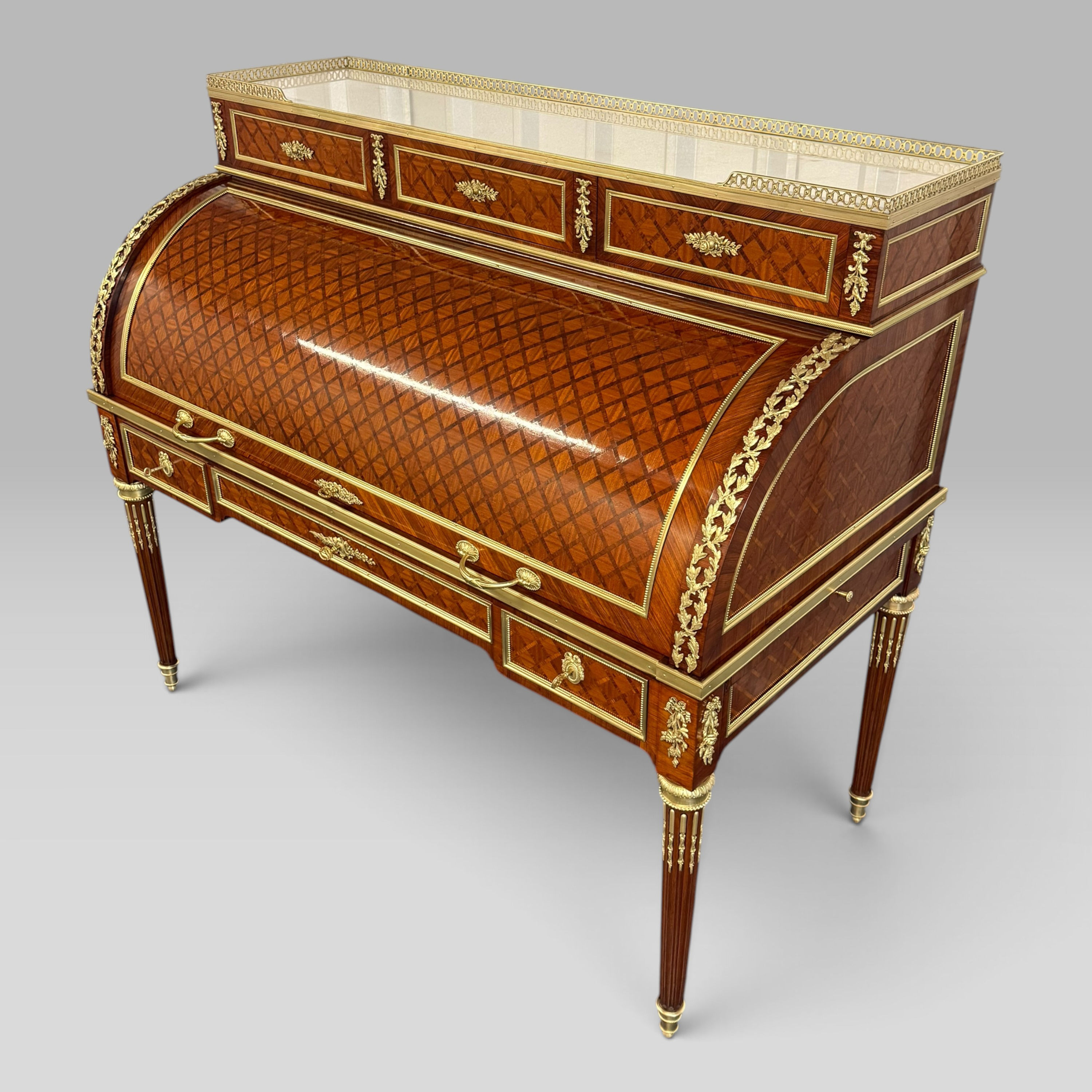

A superb mid-19th century French Louis XVI style cylinder desk, made circa 1869, veneered in kingwood, rosewood, tulipwood and bois satiné, with elaborate parquetry and finely cast ormolu mounts.
The desk is surmounted by a white Carrara marble top enclosed by a brass gallery. The cylinder front opens to reveal a fitted interior with four drawers, each incorporating fitted divisions, together with open storage space above.
The principal writing surface is inset with orange leather, finely tooled with gilt borders. This surface can be slid forward to provide additional writing space and pushed back when not in use.
To either side are extendable writing slides, each similarly inset with matching orange leather and gilt-tooled borders, providing further writing surfaces when required. The main writing surface and both side slides are framed with bois satiné and rosewood crossbanding.
The desk is richly decorated throughout with elaborate bois satiné parquetry intersected with tulipwood, creating the refined geometric decoration associated with high-quality French cabinetmaking of the period.
It stands on tapering fluted legs enriched with brass and ormolu decoration in the Louis XVI manner.
Significance & Rarity
Fine 19th century French cylinder desks of this quality are relatively uncommon. Pieces of this calibre were created for the wealthiest and most sophisticated patrons of their day, and even today furniture of this standard is most often found in important private collections, historic houses and major collections around the world. They are true collectors’ and connoisseurs’ pieces, valued not simply as functional desks but as works of cabinetmaking and decorative art.
The importance attached to the cylinder and roll-top desk has a long history in French furniture. Perhaps the most famous example is the celebrated Bureau du Roi, or King’s Desk, begun by Jean-François Oeben for Louis XV and completed by Jean-Henri Riesener. Such desks were conceived for royal and aristocratic interiors, combining privacy and practicality with the very highest standards of cabinetmaking. The enduring prestige of this form continued well beyond the 18th century, with exceptional French desks remaining prized by royalty and the greatest collectors of subsequent generations.
The present desk belongs to this tradition. Its elaborate parquetry, finely cast ormolu mounts, Carrara marble top, fitted cylinder interior and multiple leather-lined writing surfaces demonstrate the level of workmanship expected of the leading Parisian workshops. Combined with its condition, the concealed cabinetmaker’s inscription dated 1869, and its stamped Parisian locks, it represents a particularly rare surviving example of a high-quality French cylinder desk from the mid-19th century.
What is a Cylinder Desk/ Bureau?
The cylinder bureau developed during the 18th century as a more sophisticated evolution of the earlier slant-front writing bureau. Its curved cylinder front could be closed and locked when the desk was not in use, allowing the owner to conceal and secure letters, papers and other personal documents within the fitted interior.
This combination of practical privacy, concealed storage and an elegant writing surface made the cylinder bureau particularly fashionable among wealthy households during the late 18th and 19th centuries.
Makers Marks & Stamps
This desk does not bear a fully identifiable maker’s mark; however, the quality of its construction, parquetry and ormolu places it firmly within the work of the leading French cabinetmaking workshops of the mid-19th century.
Its design and workmanship show similarities to pieces by celebrated makers such as Henry Dasson and Paul Sormani, while certain elements also anticipate the style later associated with François Linke. Were it not for the earlier date of manufacture, the similarities in design and execution might invite comparison with Linke’s later work. It is therefore possible that pieces of this type formed part of the broader decorative vocabulary from which later Parisian cabinetmakers developed their own designs.
During the restoration and preservation of the cylinder bureau, an original pencil inscription was discovered on the reverse of the fitted interior compartment. This inscription was only revealed after the roll-top mechanism had been removed and the fitted section drawn forward.
The surviving pencil inscription is partially indistinct and appears to read:
“[word] Le Cassius … 02 69 [word]”
The words before and after the inscription are no longer clearly legible. The name or phrase “Le Cassius” has not been identified in the principal reference works as a known cabinetmaker or workshop. It may instead relate to an individual craftsman working within a larger Parisian workshop, or possibly to an internal workshop notation.
Of particular importance is the clearly legible “02 69”, which is most plausibly interpreted as February 1869. The desk is stylistically and constructional consistent with the mid-19th century, so this concealed inscription strongly reinforces and refines the dating of the piece to 1869. As the inscription is original to the construction and was hidden behind the fitted interior, it provides particularly useful evidence for establishing the date of manufacture.
Lockmaker’s Stamp
The lock plates from the three lower drawers have been removed, revealing the stamped lockmaker’s mark: “Mon Theau / Thieffine SUCR / SERRURIER / PARIS”. This Parisian lockmaker is not extensively documented, although a small number of known examples appear on furniture by some of the leading French cabinetmakers of the late 19th century. Comparable stamped locks have been recorded on an exceptional commode attributed to François Linke, circa 1885, and on a sideboard or cupboard associated with Zwiener, Jansen Successeur.
Taken together with the present desk, these examples suggest that this lockmaker supplied fittings to some of the foremost Parisian cabinetmaking workshops from at least the 1860s through to the late 19th century. The presence of these stamped locks therefore provides a further useful indication of the quality and Parisian manufacture of the desk.


