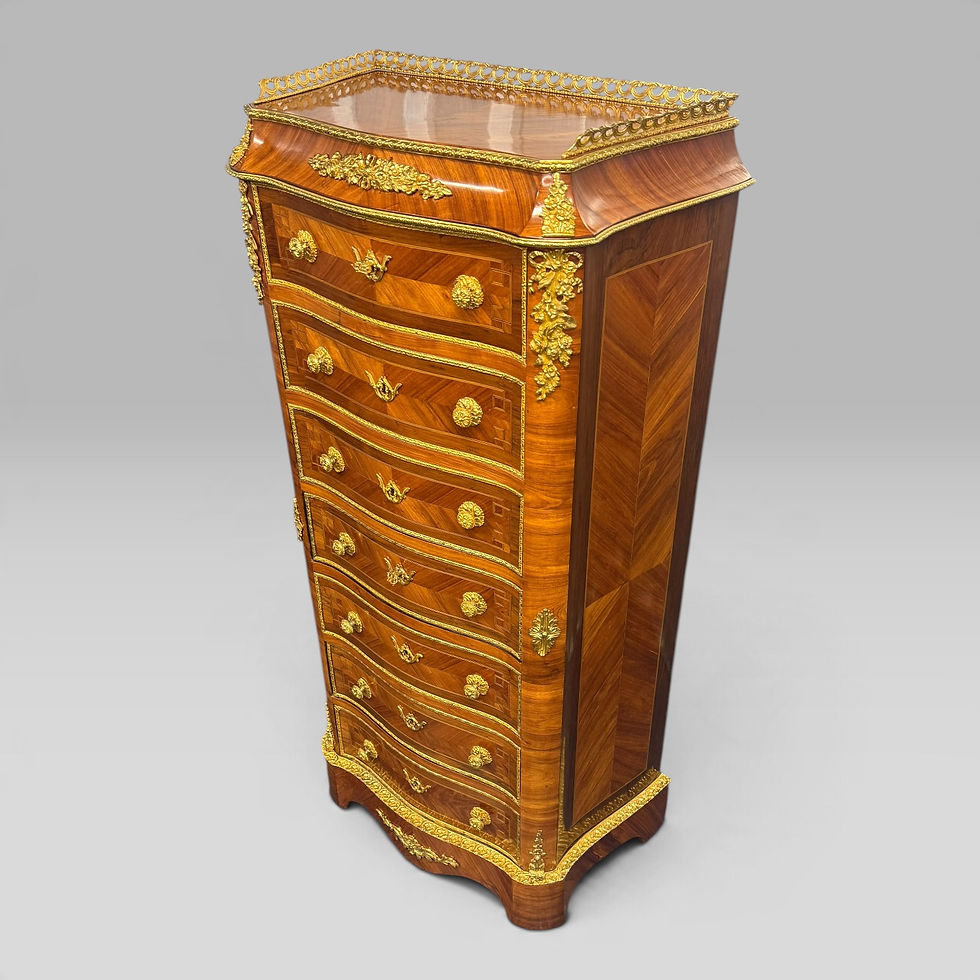
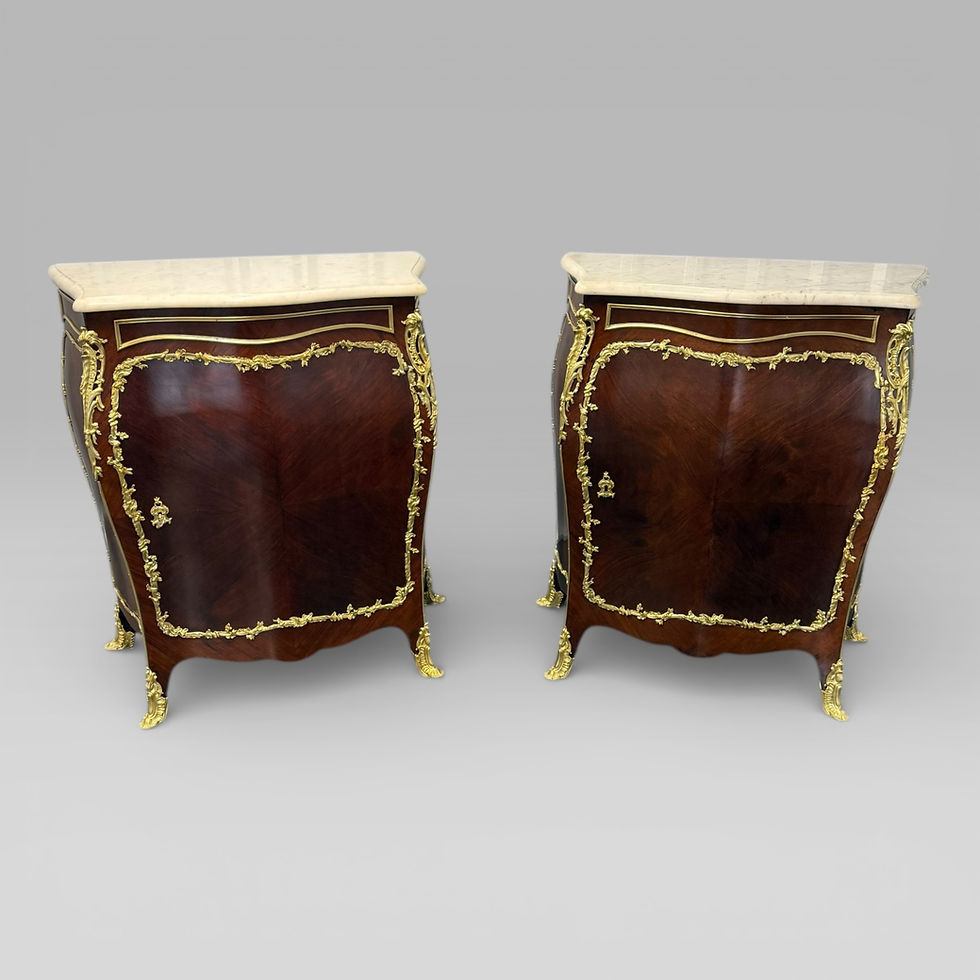
An important North Italian Tuscan Baroque commode, manufactured in Florence circa 1690–1720 and attributed to the Grand Ducal Workshops of the Medici court. Representing the highest level of Florentine cabinetmaking of the period, it is inlaid throughout with exceptionally fine ivory and pewter in the Venetian manner, fitted with finely cast ormolu handles based on designs by Giovanni Battista Foggini, and retains an original partially faded circular “LC” stamp to the underside.
Made for the wealthiest aristocratic and noble patrons by leading cabinetmakers and specialist craftsmen, the commode survives as an exceptional example of Florentine Baroque furniture. On the basis of its quality, rarity, construction, decoration and the comparative evidence identified during our research, we consider it among the most significant North Italian commodes of this period to appear on the market in recent years.
Of breakfront form with projecting canted corners, the rounded overhanging top is constructed in walnut with exceptional areas of richly figured burr walnut, framed by rosewood crossbanding, and centred with floral marquetry enclosed by inlaid borders. The same rosewood crossbanding continues around the sides, with further floral inlaid centrepieces set against walnut and burr walnut veneers.
Each drawer is individually decorated with floral ivory and pewter inlay and fitted with Foggini-designed ormolu handles and ormolu key escutcheons. The canted corners are inlaid from top to bottom with finely engraved dogs, hounds, birds and scrolling foliage, culminating in a lion within the frieze above each corner.
Rarity, Research & Attribution
We have undertaken extensive research into this commode, consulting leading Italian furniture specialists, international dealers, authors and historians, and comparing it with documented examples in museums, former Medici residences, private collections and the international art market.
One of its most unusual features is the ivory and pewter marquetry. Professor Enrico Colle documents related Florentine commodes in his published studies of Medici furniture, yet we have been unable to identify another Tuscan example with marquetry of precisely this character.
In consultation with a leading international specialist in Italian furniture, the closest comparison suggested for the inlay was the work associated with the mysterious Venetian cabinetmakers known as the “3Cs”. Their furniture is generally much more extensively inlaid, but similarities exist in the treatment of the decoration. Their furniture can also bear a circular brand incorporating three “C”s; however, published examples are associated with a noble coat of arms incorporating chequered eagles, while the present stamp appears instead to read “LC”. We therefore do not attribute this commode to the 3Cs; the comparison is important only as one of the closest parallels presently identified for the inlay.
Although Florentine in manufacture, the ivory and pewter decoration is executed in the Venetian manner, combining eastern flowing floral and foliate ornament with Western figurative subjects including lions, dogs, hounds and birds, reflecting Venice’s historic position as a major trading port between East and West.
A particularly significant comparison appears in Professor Colle’s work on the Palazzo Pitti, where a Grand Ducal Workshop commode has one of the closest related carcass forms identified during our research. Its bronze handles are also remarkably close to those on the present commode and relate to designs by Giovanni Battista Foggini (1652–1725), Grand Ducal Sculptor to the Medici court.
A further closely related commode survives at Villa La Quiete, another former Medici residence, and is associated with the same Florentine court workshop tradition. The closest documented comparisons presently identified therefore come from furniture connected with the Medici court and Grand Ducal Workshops.
The exceptional cabinetmaking, ivory and pewter inlay, burr walnut veneers, engraved decoration and Foggini-designed mounts indicate a commission of considerable importance, likely requiring several specialist craftsmen including a master cabinetmaker, inlayer, engravers and bronze workers.
On the balance of the evidence, we attribute the commode to the Grand Ducal Workshops or to a leading Florentine master workshop working directly within the Medici court sphere. The Palazzo Pitti and Villa La Quiete comparisons, Foggini-designed mounts, exceptional workmanship and unusual inlay strongly support this attribution. No surviving document has yet been identified directly linking this specific commode to a recorded Medici commission or named Grand Ducal cabinetmaker, so the attribution remains based on the strongest available comparative evidence rather than a conclusively documented workshop identification.
Research into the commode is continuing, as we believe its exceptional quality and unusual decoration warrant further investigation, with the aim of establishing its precise workshop and original commission should further documentary or comparative evidence come to light.
(Please Note: this is a shortened description - please contact us for the full length description of this commode)
Ivory Reference: HJ5J96CX