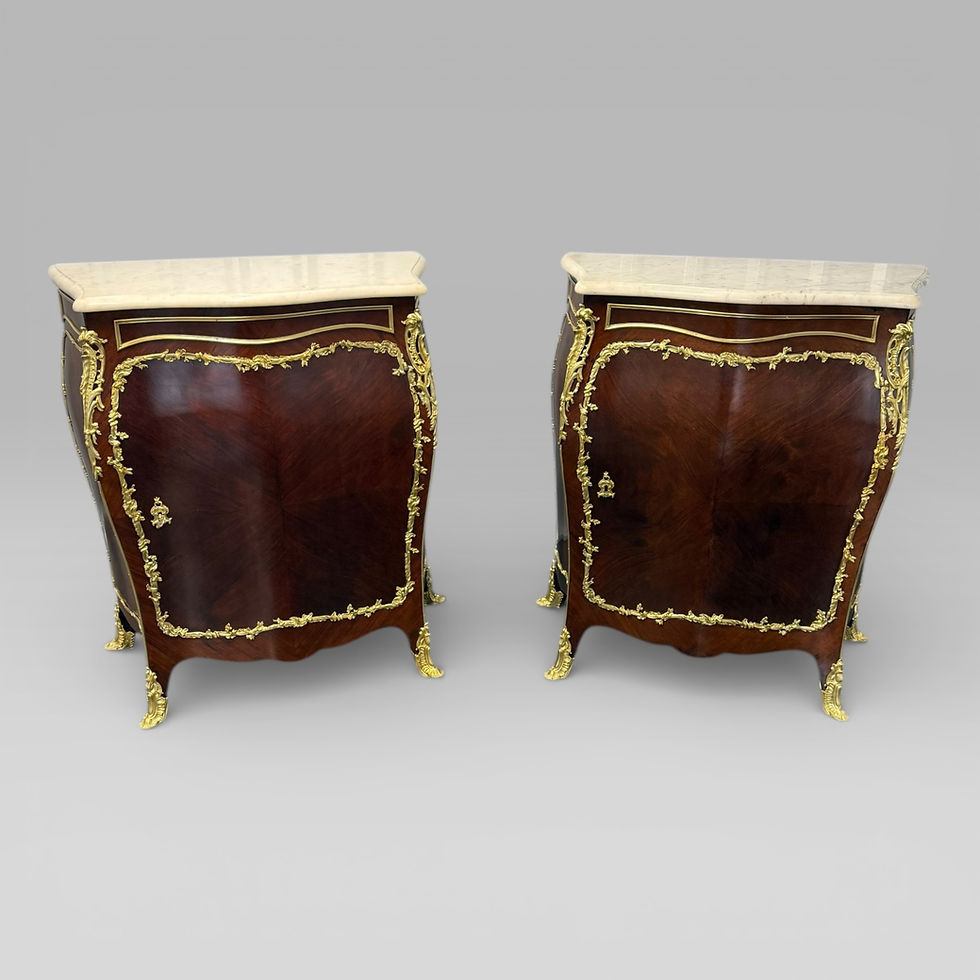
Here we have an extraordinary ormolu-mounted pier cabinet with a smoothly bevelled Vert Maurin marble top (a green marble from the French Alps), made circa 1820–1840 and formerly retailed and assembled by Edward Holmes Baldock (EHB), regarded as one of the most important English furniture dealers of the early to mid-19th century, and featuring marquetry attributed to the Blake family, among Britain’s leading marquetry and Boulle inlayers of the period. The cabinet is of substantial size and features protruding canted corners to the front.
Edward Holmes Baldock was known for incorporating important 17th and 18th century elements from earlier furniture into pieces he retailed, and this cabinet is an exceptional example of that practice. To the centre of the front is a naturalistic marquetry panel depicting an urn of flowers on a stand, resting above scrolling shaped forms. The veneers are particularly thick and finely worked, and this panel is estimated to date from the late 17th to early 18th century, likely of continental origin.
This central panel is framed by an ebony border with naturalistic floral marquetry, also believed to date from the late 17th or early 18th century. The marquetry to the sides is executed in the manner of André-Charles Boulle (1642–1732). For comparison, a cabinet in the Wallace Collection, attributed to André-Charles Boulle and dated circa 1670–1675, displays closely related marquetry decoration. That example is constructed of oak, ebony, tortoiseshell, brass and marquetry, and shows very similar floral designs.
The cabinet is fitted with impressive ormolu mounts, many of which appear to originate from earlier furniture and were carefully selected by Baldock. The most striking mounts run vertically up each canted corner of the front, topped with scrolling arched forms and decorated with floral detail. A closely comparable French commode in the Victoria and Albert Museum, dating to circa 1720, features remarkably similar brass columns terminating in hoof feet. Although that important commode bears no definitive maker’s stamp or provenance, specialists at the V&A have suggested that it is most likely attributable to the workshop of André-Charles Boulle.
The strong similarity between the mounts may suggest that the ormolu on this cabinet was either inspired by Boulle’s designs, copied from them, or possibly even cast from the same master models used for the earlier commode.
Most of the brass elements on the cabinet, including stringing and borders, are attached using bolts, a construction method characteristic of 18th century French ormolu mounts, rather than the later practice of simply pinning or screwing mounts to the surface. At the top of each front column is a mounted head with small horns, forming a matching pair. Combined with the hoof-form feet below, these mounts may represent a faun, the Roman mythological figure that is half human and half goat, associated with rustic woodland and animal spirits.
The side panels also incorporate earlier decorative elements. Each side features a trellis marquetry panel taken from an 18th century French furniture piece, and carefully integrated into the cabinet’s construction.
The frieze of the cabinet is inlaid with marquetry dating to the same period as the cabinet itself, circa 1820–1840, and this decorative band continues around to the sides. This section of marquetry is attributed to the Blake family (Richard Blake, Charles Blake, Henry, George and James Blake), regarded as among Britain’s leading marquetry and Boulle inlayers of the early to mid-19th century, and craftsmen whom Baldock is known to have employed on numerous important pieces.
The cabinet is stamped “EHB” to the top of the back, confirming the association with Edward Holmes Baldock. The locks are working and new keys have been cut for both the door and the drawers. The cabinet stands on casters, allowing it to be moved easily. The doors open to reveal a shelved oak-lined interior with two adjustable shelves.
Woods Used in the Cabinet
This cabinet is constructed from a variety of fine timbers, with the carcass primarily of oak. The sides are predominantly veneered in rosewood, with kingwood veneered panels above and below the trellis marquetry sections. To the front, the door is framed by an ebony border, and the upper drawer incorporates coromandel veneers. The door frame itself is finished in a burr yew veneer, adding a subtle but beautiful contrast to the overall appearance.